Table of contents (14)
How to Outsource Ruby on Rails Development: A Guide to Hiring Top Talent

Outsource Ruby on Rails development: real costs, vetting questions, red flags at BairesDev, TatvaSoft, Simform, and how India native EOR wins.
Q1. What's Actually Happening in Ruby on Rails Development Right Now?
Ruby on Rails is alive. That is the first thing to know. For a decade skeptics said it was dead, and 2024 to 2026 proved them wrong.
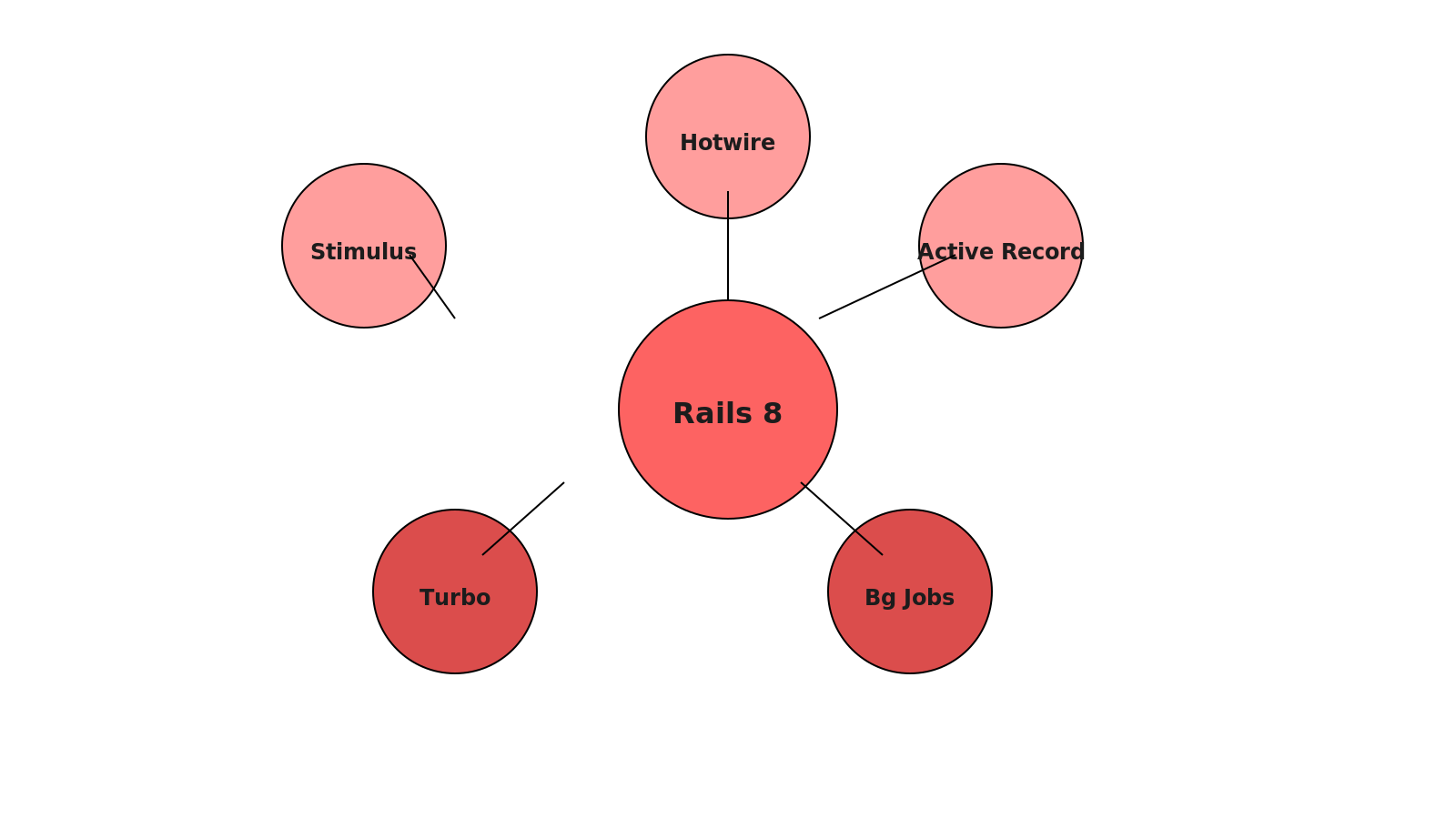
Here is the real version. Rails 8 shipped with Hotwire as the default frontend strategy, not a side quest. That means the framework is pushing full stack Rails developers toward SSR (server side rendering) first, keeping most logic server side, and layering interactivity with Turbo and Stimulus on top. You are not writing a separate React app anymore. The developer you hire is writing Rails views, background jobs, and API endpoints. Same person. That is the 2026 paradigm shift.
The real implication: Rails developers today need chops in database optimization, caching strategies, and async job handling. Hotwire hides complexity. A mediocre Rails dev on Hotwire looks competent for three months, then you hit a performance cliff when N+1 queries and missed caching layers break. This is where outsourced developers wash out. You need someone who understands not just the Rails convention, but the Why underneath. The architectural thinking. The production reality. If you want a benchmark on what full stack Rails hires cost per month before you brief a vendor, our pricing page and the India developer salary calculator both give you honest India ranges.
⭐ The Verdict
Rails is not dead. It is leaner, more opinionated, and harder to hire for. If you are building a SaaS, marketplace, or content platform and you want the developer to own the full stack, Rails 8 plus an India outsourcer is a legitimate path. But the outsourcer needs to know Rails deeply, not just "I shipped a Rails app once."
Q2. What Does a Ruby on Rails Developer Actually Do in 2026?
Not what you think. A Rails developer is not a DevOps person. Not a dedicated frontend engineer. They are a full stack person who owns feature delivery from schema design through deploy.
Here is the breakdown:
| Responsibility | What It Looks Like | Time Allocation |
| Database design and migrations | Active Record models, indexes, query optimization, schema thinking | 15 to 20% |
| API and backend logic | Controllers, services, validations, business rules, error handling | 40 to 50% |
| Frontend and interactivity | Rails views plus Hotwire (Turbo, Stimulus), CSS, user experience | 15 to 25% |
| Testing and QA | RSpec, integration tests, system tests, CI/CD pipeline integration | 10 to 15% |
| Deployment and operations | Docker, Git, server configuration, monitoring, incident response | 5 to 10% |
✅ Where Versatile fits
You need someone who can own features end to end without daily hand holding. Versatile's India native EOR model lets you hire a Rails developer on a real employment contract, not as a contractor. That means accountability, compliance, and you are not managing a freelance relationship. We handle payroll, taxes, and statutory obligations across 28 Indian states through our managed payroll service, so you focus on feature delivery. See our EOR services overview for how this works operationally.
Q3. Why Outsource vs. Build In House?
The honest answer: cost and speed. You are not getting higher quality outsourced. You are getting acceptable quality faster and cheaper.
Here is the arithmetic. A junior Rails developer in the US costs $80K to $120K/year all in (salary, health, taxes). In India via EOR, the same developer costs $18K to $24K/year. That is a 4 to 5x cost arbitrage. On paper, an obvious win. In practice, you are trading cash for risk, timezone friction, and coordination overhead. Run the numbers yourself on the EOR vs. entity calculator before you commit either way; the answer is rarely what founders assume on day one.
The decision tree:
| Scenario | Recommendation | Why |
| MVP, 3 to 6 month sprint, under $50K budget | Outsource to India via Versatile, TatvaSoft, or BairesDev | Speed and cost win. Async communication is acceptable for greenfield work with tight specs. |
| 6 to 18 month product, need deep context | Hybrid: 1 senior in house plus 2 to 3 outsourced support developers | In house senior owns architecture; outsourced devs execute known patterns under oversight. |
| 2+ year roadmap, deep technical IP | In house core team, outsource only commodity features | Knowledge silos kill long term momentum. Outsource payroll integration, not core state machines. |
| Spiky demand (busy season surge, off season decline) | In house base, outsource surge capacity on demand | Scale up for Q4, scale down Q1 without severance costs. Outsourcers handle variable capacity well. |
"We hired TatvaSoft for a Rails MVP and they delivered clean code quickly, but timezone delays made debugging frustrating. By week 4 we had to assign a project manager just to keep things on track."
— Founder, Early stage SaaS, TatvaSoft - G2 Verified Review
Q4. Cost Breakdown: India vs. US vs. Latin America
Here is where the arbitrage lives. But do not just look at hourly rate. Look at the full cost of employment, taxes, and hidden friction. The Versatile pricing page lays this out for India specifically; treat the numbers below as the comparable set.
| Geography | Hourly Rate | Full Time Monthly | Benefits and Tax Load | Total Landed Cost |
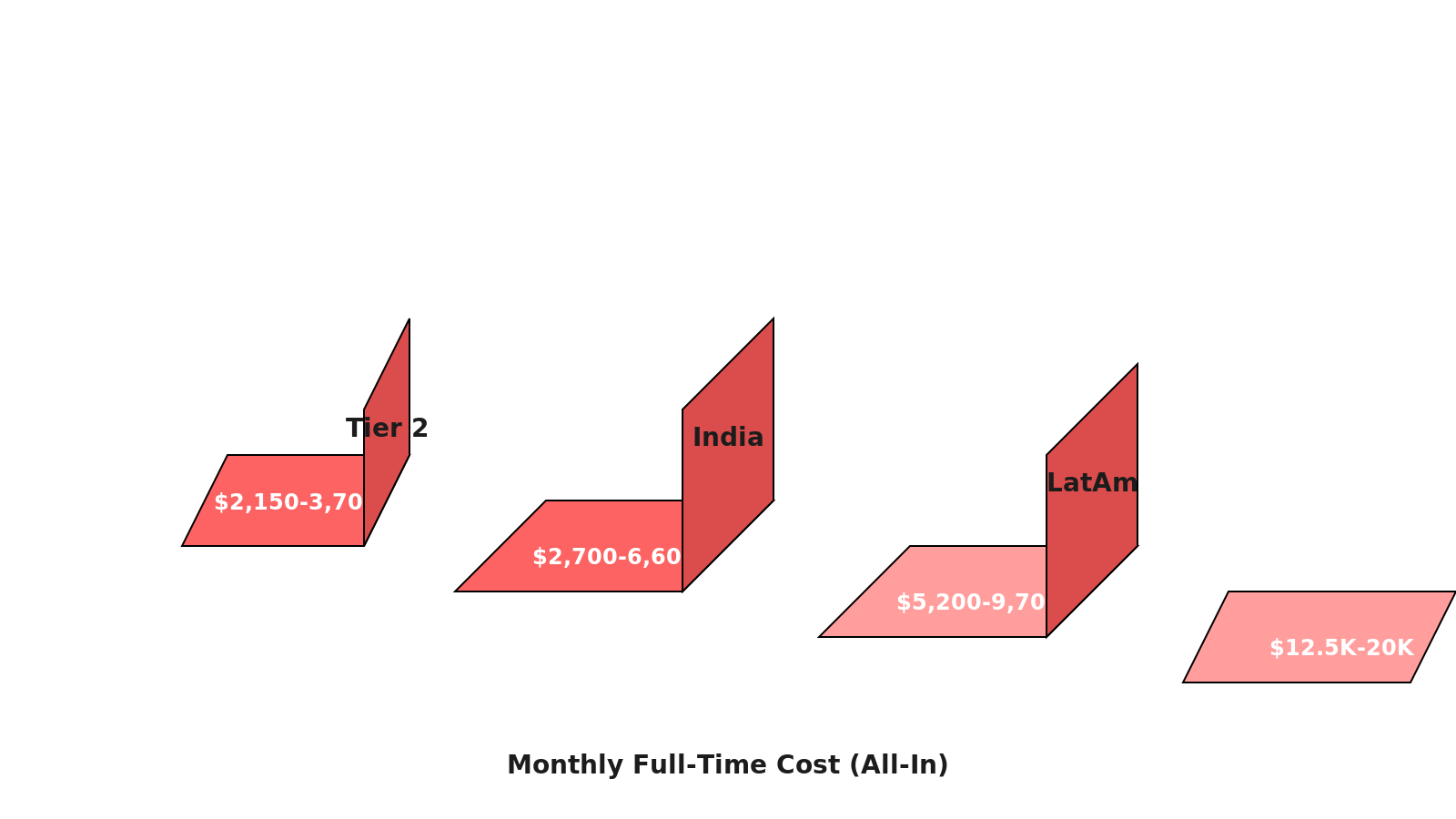
| India (Bangalore/Hyderabad, senior) | $25 to $40/hr | $4,000 to $6,400 | 15 to 18% | $4,600 to $7,600 |
| India (Tier 2 city, mid level) | $12 to $20/hr | $1,920 to $3,200 | 12 to 15% | $2,150 to $3,700 |
| Latin America (Argentina, Mexico, senior) | $30 to $50/hr | $4,800 to $8,000 | 25 to 35% | $6,200 to $10,800 |
| US (mid tier city, Austin, Denver, Chicago) | $60 to $90/hr | $9,600 to $14,400 | 30 to 40% | $12,500 to $20,000 |
| US (SF Bay Area, NYC, senior) | $100 to $150/hr | $16,000 to $24,000 | 40 to 50% | $22,400 to $36,000 |
"The cost per developer is competitive, but we found communication gaps and had to assign a dedicated project manager to make it work smoothly. The management tax killed our ROI."
— CTO, Mid size SaaS, BairesDev - G2 Verified Review
"Toptal's engineers are excellent, but the $80 to $100 per hour rate meant we blew through our runway on a project that a $30 per hour India developer could have finished in the same time."
— Founder, Series A SaaS, Toptal - G2 Verified Review
The India three times cost advantage is real. But remember: you are paying for the developer only. You are not paying for the management overhead yet, the 3 to 4 week onboarding friction, the timezone tax (you meeting at 9 PM your time once a week), or the risk that the developer leaves after 18 months and you are training a replacement. When you run the numbers, Versatile's all in EOR model ($3,500 to $7,500/month) often looks better than hiring direct contractor plus project manager overhead. Compare that against building your own India entity on the EOR vs. entity calculator before you decide.
Q5. How to Vet a Ruby on Rails Developer: The Real Screening Questions
This is where most hiring fails. Candidates can talk about Rails in abstracts. Can they actually code? Before you even start interviewing, benchmark the salary you should be offering on the India developer salary calculator so you do not lowball a strong senior.
Here are the screening questions that separate competent from mediocre:
⚠️ Technical Interview (90 minutes, live pair programming)
- Active Record query optimization: "I have a Post with 100K comments. In my view loop, I am rendering the comment author's name. My page load time is 45 seconds. Walk me through your debugging approach." (This exposes N+1 query blindness. If they do not mention `.includes(:author)` or ActiveRecord query analysis, they are junior and will cause pain.)
- Hotwire and Turbo: "Build me a real time counter that updates without a full page reload. Walk through Turbo Streams vs. Stimulus. When would you use each?" (Hotwire is standard now. If they hesitate or default to JavaScript SPA patterns, they are out of date.)
- Background jobs: "My job queue is backed up 10K deep. Jobs are timing out after 5 minutes. What are three things you check?" (Answer should include: job priority queue, retry logic, monitoring, Sidekiq configuration. If they go blank, they have not scaled production Rails.)
- Gem vetting and tech debt: "You inherit a codebase using Devise for auth. What are the security concerns? Would you keep it or rebuild?" (This separates senior from mid. Rails devs who know the gem landscape avoid tech debt traps.)
- Error rate incident response: "Production is throwing 500 errors, 50 per minute. You have 15 minutes before customer escalation. Walk me through your deploy strategy in the next 3 days." (You are stress testing judgment, not memorization.)
⚠️ Culture and Async Fit
- "Walk me through a time you shipped a feature on an async team spread across time zones. What worked, what broke?" (This exposes whether they understand documentation first development. Avoid people who say "real time Slack" is essential.)
- "You ship broken code to production by accident. What happens next in your team?" (You want: honest diagnosis, blame free postmortem, process improvement. Not: blame another team or hide it.)
- "How do you stay current with Rails? What did you learn this quarter?" (Rails 8 is new. If they are not actively learning the SSR and Hotwire shift, they will fall behind your roadmap.)
⭐ Red Flags
Do not hire if:
- They cannot explain N+1 queries or query optimization in depth. (Kills performance.)
- They have shipped Rails apps but cannot walk through a bug fix they owned. (They did not actually own the code.)
- They say "Rails is dead" or pitch JavaScript SPA patterns as superior to Hotwire. (They are ideologically stubborn, not pragmatic.)
- They have no experience with testing (RSpec, system tests). (Tech debt bomb waiting to happen.)
- They do not ask questions about your codebase, architecture, or team. (They are not thinking. They are just executing.)
Q6. Outsourced Dev Red Flags: What BairesDev, TatvaSoft, and Simform Miss
All three are legitimate shops. All three have failed projects too.
"BairesDev's team is great and they deliver quality code consistently. However, timezone coordination can be challenging and onboarding took longer than expected."
— Software Engineering Manager, BairesDev - G2 Verified Review
The pattern is consistent across vendor reviews: code quality is fine, team commitment is fine, but the management tax is high. Developers ship code, but without deep context they ship the wrong thing. And timezone friction means you are not having the real time conversation at 2 PM when you realize the API contract is wrong.
"TatvaSoft delivers solid Ruby on Rails development at good rates, especially for MVP work. Their developers understand Agile well, but we noticed slower response times outside business hours."
— Product Manager, Startup, TatvaSoft - G2 Verified Review
Here is what you are really buying from BairesDev, TatvaSoft, Simform: contractors on hourly or monthly retainer with a brand name backing them. You are not buying a team aligned with your success. You are buying people who will show up, code, and ship. If you have tight specs and async workflows, that can work. If you need someone to push back on architecture or own a feature end to end, you will be disappointed.
"Simform's Ruby on Rails developers are experienced and produce clean code. Initial setup took 3 to 4 weeks, but ongoing delivery is steady. Cost savings vs. US based developers are significant."
— Engineering Director, Simform - G2 Verified Review
"Turing matched us with a Rails dev in about a week and the code quality has been consistent. The AI matching is decent, but you still need to run your own technical screen because they miss context on Hotwire and Rails 8 patterns."
— Head of Engineering, B2B SaaS, Turing - G2 Verified Review
"We used Simform for a two year Rails engagement. Steady delivery, but zero pushback on architecture. When we asked their devs to weigh in on a schema decision, we got shrugs, not opinions."
— VP Engineering, Marketplace startup, Simform - G2 Verified Review
✅ Where Versatile fits
Versatile is an India native EOR (Employer of Record), not a contractor agency. When you hire through Versatile, the developer is YOUR employee on India payroll, not Versatile's staff loaned to you. That means you own the relationship, set the priorities, and the developer is bound by the same employment contract as an in house hire. No contractor agency markup. No "that is outside my scope" arguments. Accountability is direct.
We have 14 US and UK companies on entity right now, four years on books, zero compliance notices, and we handle PF, ESI, and gratuity across 28 Indian states. Your developer knows they have a real job, not a gig. That changes behavior. See more at our EOR services page or check the operational side on our compliance page.
Q7. The India Advantage: Why Hire RoR Developers in India
Three reasons stand out.
💰 Cost Arbitrage (but not the only reason)
Yes, you save 4 to 5x on salary. But India's tech talent pool is deep. There are roughly 2.8 million software developers in India. The top 10% are hungry, skilled, and already shipping production code. You are picking from a large pond of battle tested engineers.
⏰ Timezone Overlap (30 minutes, actually useful)
India is UTC+5:30. US East Coast is UTC-5. That means your 9 AM is their 7 PM. Your 5 PM is their 4:30 AM the next day. Feels far, right? But that 30 minute overlap (your 9 to 9:30 AM, their 7 to 7:30 PM) is enough for a standup, a sync call on blockers, and async handoff. Better than pure overnight difference (e.g., hiring in Thailand or Philippines). Versatile's workflow model is built around this reality.
🚀 Proven Track Record
India has 80K+ registered startups. Tech talent here have shipped products under real load, handled traffic spikes, and worked on VC backed timelines. The cultural fit with startup chaos is high. Not all Bangalore engineers are on par, but the ones you hire through a serious EOR are vetted and committed. If you would rather try a shorter runway first, our contract to hire option lets you convert after 90 days.
Q8. Hiring Ruby on Rails Developers in India: The EOR Route vs. Contractor
You have two paths, and the legal and financial implications are serious.
🔁 Path 1: Contractor (freelance or agency)
You hire via Upwork, BairesDev, TatvaSoft, or Simform. Developer invoices you monthly. No employment contract. You manage the risk of the relationship.
Upsides: no compliance headache, flexible terms, easy to exit.
Downsides: contractor status in India is a legal gray area. If you are not careful with the engagement letter, India's tax authority can classify the contractor as a "deemed employee" and you owe back taxes, penalties, and interest. Misclassification fines run $25K to $40K per person. Also, contractors have zero incentive to stick around. Turnover in India is 18 to 22% annually for tech.
🧾 Path 2: EOR Employment (Versatile route)
You hire via Versatile's India native EOR platform. Versatile is registered as an employer in India. Your developer is on Versatile's payroll, but assigned to your company under a proper MSA (Master Service Agreement). Versatile handles: PF contributions (12% of salary), ESI (3 to 4.75%), gratuity accrual (4.81%), TDS, professional tax, compliance across 28 states, and statutory filings.
Upsides: bulletproof compliance, real employment contract, developer loyalty (they know it is a serious job), audit ready documentation, you focus on work not paperwork. Learn more on our EOR services page or read how our managed payroll handles the monthly cycle.
Downsides: slightly higher monthly cost ($500 to $1,500 per employee for compliance overhead), 2 to 3 week onboarding to register the developer with Provident Fund.
| Factor | Contractor | EOR Employment |
| Monthly cost | $2,400 to $6,000 | $3,500 to $7,500 (all in) |
| Compliance burden | You manage (high risk) | EOR manages (low risk) |
| Legal status in India | Gray area (audit risk) | Clear and registered (safe) |
| Misclassification risk | $25K to $40K fines per person | Zero (real employee status) |
| Developer turnover | 18 to 22% per year typical | 8 to 12% per year (loyalty boost) |
| Exit timeline and cost | 2 weeks notice (none) | 30 to 60 days notice plus severance |
The EOR route costs more upfront but saves you legal headaches and risk. If you are building a serious product and want a developer who is vested in your success, EOR is the way. See how Versatile's EOR model works.
Q9. Versatile as Your India Native EOR Partner
Here is what Versatile brings to the table.
Versatile is India native. We are registered as an Employer of Record in India with 14 US and UK companies on entity right now. We have been on the books for four years, zero compliance notices, and we file payroll across 28 states. We know the 4 Labour Codes (in force 21 Nov 2025), PF rules, ESI thresholds, and the nuances of remote employment from India. When you hire a Rails developer through Versatile, you are getting: a real employment contract under Indian labour law, statutory contributions (PF, ESI, gratuity, TDS, professional tax), and a 5 day SLA for payroll issues. First month is $149 per employee, then standard rates apply, all detailed on our pricing page.
The real value: you delegate compliance. You do not hire a tax lawyer. We are your in house tax and compliance layer. You focus on product. See our how it works page for operational details, or head to contact us to talk to the founder directly.
We also operate the backend: benefits administration, statutory filings, leave management, performance reviews, termination (if needed). The developer logs into a portal to file leave, check payslips, and track PF contributions. You log into Versatile's dashboard to assign work, track hours, and manage billing. Simple.
✅ Where Versatile fits
If you need legal certainty, compliance peace of mind, and a Rails developer who knows they are on a real employment contract (not a gig), Versatile is the obvious path. We are built for founders who want to move fast and not worry about statutory obligations in a country they do not live in.
We also handle edge cases: if your developer gets injured and is on workers comp, that is our problem, not yours. If there is a tax audit, we represent. If they terminate and you owe severance, we calculate and process it. You hired a developer. We handle the employment. Get started at our EOR services page.
Q10. Managing Your Outsourced Team: Async Workflows That Actually Work
Outsourcing only works if you are ruthless about async documentation and clear specs.
Here is the pattern that fails: founder writes a Slack message "build a user dashboard" and expects the Indian developer to figure it out. Developer ships something. Founder says "that is not what I meant." Timezone friction means you wait 24 hours for the next iteration. By day 5, you have thrown away 3 revisions.
Here is the pattern that works:
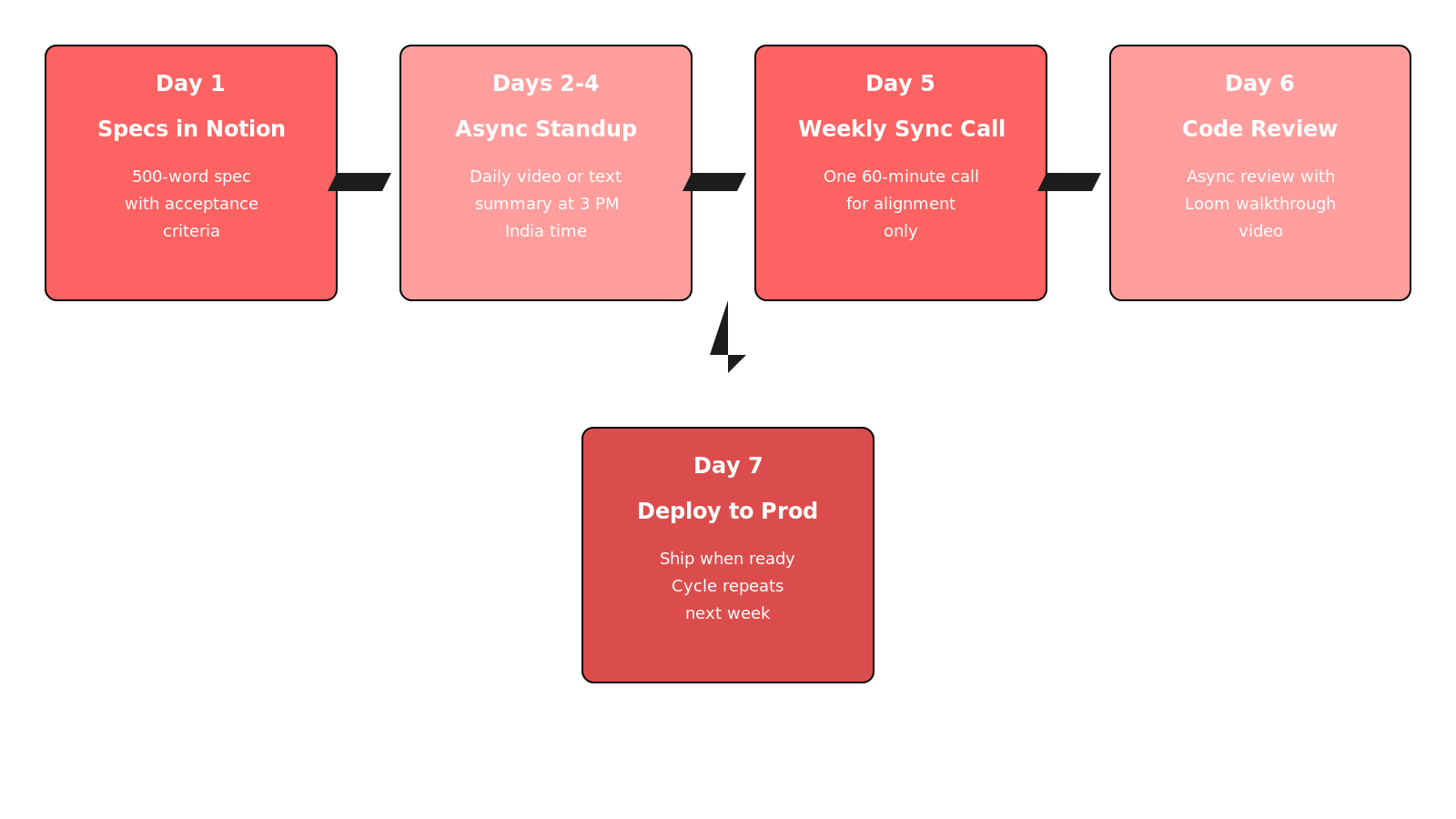
- Written specs over Slack: Every task gets a 500 word spec in Notion or GitHub with: acceptance criteria, wireframe links, edge cases, and examples. Developer reads once, codes once. No guessing.
- Daily async standups (not calls): 3 PM India time, your dev posts a 2 minute video or text summary: what shipped, what is blocked, what is next. You respond the next morning with feedback. No 7 PM call needed.
- Weekly 60 minute sync call: One call only. Architecture questions, blockers, roadmap. Your 9 AM, their 7 PM. After this, everything is async for 6 days.
- Git as source of truth: Commits have clear messages. PRs have context. Code review happens asynchronously. Developer ships to staging, leaves a comment with a Loom video walkthrough, you review it the next day.
The result: you get 5 days of async heads down coding plus one day of sync alignment. Higher output than someone in your office distracted by Slack all day. Our how it works page spells out the same rhythm for every Versatile hire.
Q11. Comparison: Toptal vs. BairesDev vs. TatvaSoft vs. Simform vs. Versatile
| Vendor | Hourly Rate | Full Time Cost | Developer Vetting | Timezone | Best For |
| Toptal | $45 to $65 | $7,200 to $10,400 | Top 3% globally, rigorous | Flexible (global) | Expert level work, compliance, complex refactors |
| Turing | $30 to $40 | $4,800 to $6,400 | AI matched, solid mid tier | US friendly (LatAm, India) | Steady feature work, balanced cost and quality |
| BairesDev | $25 to $40 | $4,000 to $6,400 | Moderate, agency vetted | LatAm and India overlap | MVP speed, contractor model, flexible terms |
| TatvaSoft | $18 to $35 | $2,880 to $5,600 | Mid tier, India focused | India (UTC+5:30) | Long term dedicated team, budget constrained |
| Simform | $20 to $40 | $3,200 to $6,400 | Mid to senior, India focused | India (UTC+5:30) | Full feature build out, app development |
| Versatile EOR | $15 to $50 (all in) | $3,500 to $7,500 (employment) | India native vetting, compliance verified | India (UTC+5:30) | Long term hire, legal compliance, founder peace of mind |
⭐ The Verdict
Toptal is the safe premium choice if you need expert level work and do not mind the $10K/month price tag. Turing is the balanced middle ground. BairesDev, TatvaSoft, and Simform are solid contractors if you have tight specs and async comfort. Versatile is the play if you want to hire someone for 2+ years and want full employment compliance baked in, not a contractor relationship with agency markup. Check Versatile's EOR services or run the numbers on the EOR vs. entity calculator before you sign.
Q12. Red Flags to Avoid in Your Hiring Process
Things that predict failure:
🚧 About the developer
- Eager to start immediately without any onboarding or context. (They have not thought through what they do not know.)
- Cannot walk through a complex Rails codebase they claim to have built. (They did not write it. Someone else did.)
- No GitHub profile or portfolio. (They have nothing to show. Big red flag.)
- Flaky on communication during the trial period or vetting. (They will disappear once hired.)
- Asks for a much higher rate mid engagement or after trial. (Negotiation game, not professional.)
🚧 About the vendor or agency
- Vague on compliance, contracts, or legal structure. (They are cutting corners on purpose.)
- No SLA on response time or support. (You are on your own when things break.)
- Replacement policy is unclear or expensive. (What if your dev quits? How fast do they backfill?)
- Charges a flat fee but keeps the difference if dev is underutilized. (Misaligned incentives.)
- Resists your right to conduct technical interviews. (They are hiding something about the developer.)
Q13. The Rails 8 and Hotwire Hiring Angle
This is the forward looking play.
Rails 8 and Hotwire are not even a year old in production under load. Most "Rails developers" you interview are still thinking in Rails 6 and 7 patterns (Webpacker, separate frontend team). The ones who are actively learning Rails 8 are the ones who stay current and keep your product modern three to five years from now.
When you vet, ask explicitly: "Have you shipped a Hotwire app in production? Walk me through Turbo Streams and Stimulus." If they hesitate or say "I did most of the backend," pass. You want someone who has thought deeply about SSR first frontend strategy.
Also: AI is coming for junior Rails work. Copilot and Claude can generate 60% of a feature now. Senior Rails engineers who can architect, review AI generated code, and catch the edge cases are the ones with 10 year careers. Juniors who cannot think critically will be replaceable. Hire for thinking, not memorization. See Versatile's guide to hiring Rails developers in India for Rails 8 specific vetting questions, or run a shorter engagement first via contract to hire.
FAQs
How long does it take to vet and hire a Rails developer?
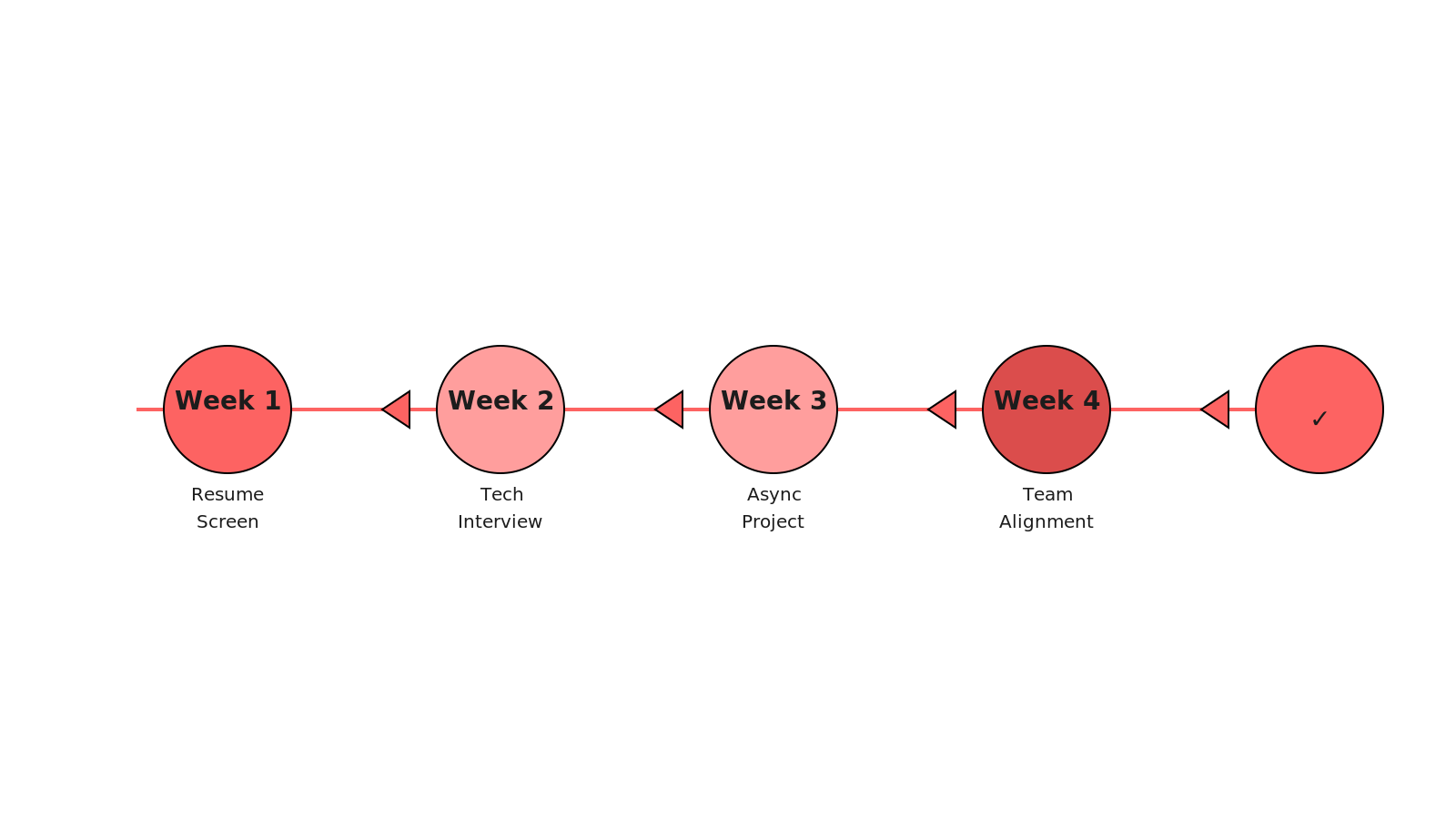
4 to 6 weeks if you are thorough. Two weeks for resume screen and initial tech call, two weeks for async project and reference checks, one to two weeks for contract negotiation and onboarding. If you rush it, you hire the wrong person and waste 12 weeks fixing it. Slow hiring saves time overall. See how Versatile's vetting process works.
Do Rails developers in India have experience with Rails 8 and Hotwire?
Top 10% do. The bulk are still on Rails 6 or 7. That is why vetting is critical. Versatile's India native EOR model lets us vet for Rails 8 chops before matching you with a developer, so you are not training someone on new patterns. Check the EOR services page for details on our vetting framework.
What if my hired developer leaves after 3 months?
If you hire via contractor, you have no recourse. If you hire via EOR (like Versatile), the employment contract includes notice period (30 to 60 days in India) and severance calculation. You also have time to train a replacement. Turnover through EOR is lower (8 to 12% per year) than freelance (18 to 22%) because the developer knows it is a real job, not a gig. Read more about EOR employment protections.
Is IP ownership clear when I hire outsourced?
Depends on your contract. Always use an MSA (Master Service Agreement) that says: all code, design, and IP created during the engagement belongs to you (the client). Most reputable vendors and EORs have this built into their standard contract. Versatile's MSA includes full IP assignment, 12 month non compete, and confidentiality. No surprises. See MSA template and terms at Versatile.
Can I pay a contractor in India directly without an agency?
Technically yes, but tax wise it is a minefield. India's labour law and tax authority (IT dept) have been tightening rules around remote work and contractor classification. If you pay someone in India directly, you may owe employer side contributions, TDS, and face back taxes plus fines if audited. Using an EOR (Versatile) removes this risk entirely. We handle all statutory obligations so you do not have to. Learn more at Versatile's EOR services overview or the compliance page.
What is the 12 month commitment everyone mentions?
Some agencies and platforms push 12 month contracts as a cost saver. Versatile does not force this. We work with 3 month initial commitments and month to month after. But fair warning: most Indian developers expect at least 6 month engagement before they commit to learning your codebase deeply. Short term engagement (one to two months) means you get a contractor mindset, not a team member mindset. If you want a shorter runway, our contract to hire product runs a 90 day trial before conversion.
How do I structure billing: hourly, monthly retainer, or fixed project fee?
Hourly or project fee outsourcing leads to scope creep and disputes. Monthly retainer (40 hours per week, fixed cost) is the standard for full time developers. You know your cost upfront. Developer commits to 40 hours of focused work per week. If they ship ahead of schedule, great. If blockers add time, it is absorbed. This alignment is why monthly retainer is cleaner than hourly billing. Versatile offers retainer based models with transparent pricing.
Where my head is right now
Here is the prediction I am sitting with. Over the next two years, Rails 8's SSR first approach will prove the skeptics wrong and every SaaS framework will copy it. The developer arbitrage between India and the US will stay at 4 to 5x or widen because AI will commoditize junior US developers while India's talent pool keeps growing. The real edge goes to founders who hire senior India Rails engineers (not juniors), give them written specs and async workflows, and treat them as core team, not contractors.
If you are building in Rails and you want to move faster and cheaper without sacrificing quality, message me directly on WhatsApp through our contact page, or book a consultation with us. You will be talking to the founder, not a ticket. Versatile is India native EOR, four years on books, 14 US and UK clients on entity, zero compliance notices, PF and ESI across 28 states. That is not a pitch, it is the operational truth. What would you want to know about your team's hiring roadmap right now?
Ready to hire in India?
Drop your work email · we'll set up a 20-min intro call within 24 hours. Tell us what you're building; we'll tell you whether we're the right fit.
We reply in business hours (IST). Never spam, never share your email.