Table of contents (12)
The .NET Framework: A Founder's Guide to Hiring, Migrating, and Running .NET Teams in India in 2026

Explore the .NET Framework's history, core components, features, supported languages, and its evolution into the unified .NET platform.
Q1. What is the .NET Framework, and does it still matter in 2026?
The .NET Framework is Microsoft's original managed-code runtime, first released in February 2002. It sits on top of Windows, ships a Common Language Runtime (CLR) that executes managed code, and pairs that with a Framework Class Library (FCL) covering everything from file I/O to XML parsing to Windows Forms UI.
📇 The one-sentence definition
The .NET Framework is a Windows-only application platform that lets you write in C#, F#, or Visual Basic .NET, compile to Common Intermediate Language, and run inside the CLR against a shared class library of roughly 20,000 types.
You are still shipping it today if you maintain an enterprise ASP.NET Web Forms line-of-business app, a WCF SOAP service behind a corporate firewall, a WinForms internal tool, or any legacy service written before 2019. Version 4.8.1 (August 2022) is the last major release. Microsoft is not shipping 4.9 or 5.x. The forward path is .NET Core, now rebranded as just .NET. If you are staffing that split between a frozen 4.8 line and a greenfield .NET 10 line, our India-native EOR service is where most US and UK founders end up landing that engineering team.
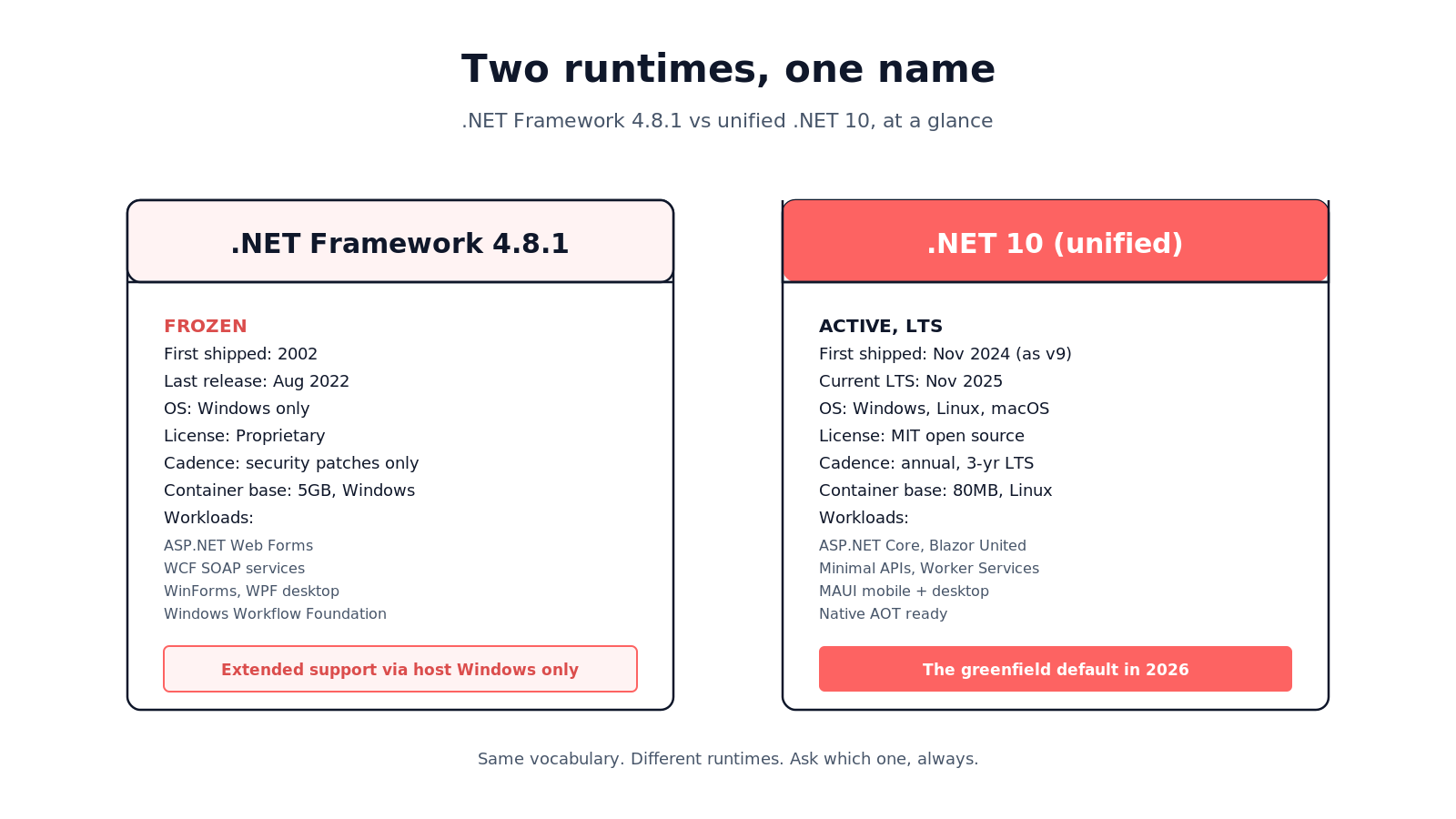
⚠️ The confusion nobody prints on the front page
There are two products that both call themselves ".NET" in 2026. The classic .NET Framework, currently 4.8.1, Windows-only, in extended support. And unified .NET, currently .NET 9, cross-platform, open-source, MIT-licensed. When a candidate says they know .NET, ask which one. When a job spec says .NET 4.8 versus .NET 9, treat them as different platforms with overlapping vocabulary. You will hire the wrong person if you skip this question.
| Attribute | .NET Framework 4.8.1 | .NET 9 (unified) |
| First shipped | February 2002 | November 2024 |
| OS support | Windows only | Windows, Linux, macOS |
| License | Proprietary | MIT (open source) |
| Update cadence | Frozen, security patches only | Annual, LTS every 2 years |
| Primary workloads | ASP.NET Web Forms, WCF, WinForms, WPF | ASP.NET Core, MAUI, Blazor, Console, Worker Services |
| Deployment | Machine-wide install | Self-contained or framework-dependent |
| Container-native | Windows containers only, heavy | First-class Linux containers, 80MB base image |
If a project brief says ".NET" without a version, that is your first clarifying question. See our how-it-works page for the exact intake form our team uses when a US founder briefs us on their first India .NET hire.
Q2. How did .NET evolve from 1.0 to unified .NET 10?
Nineteen years of shipped releases, three architecturally distinct eras, one continuous developer platform. The version history matters because most enterprise .NET codebases still carry constraints from a specific era.
🚀 The three eras of .NET
Era 1 (2002 to 2015): Classic .NET Framework 1.0 through 4.6. Windows-only. Machine-wide install. Language innovation via C# 2.0 through 6.0 (generics, LINQ, async/await). This is the codebase you inherit at most Fortune 500s and government agencies.
Era 2 (2016 to 2019): The .NET Core detour. .NET Core 1.0 shipped in June 2016 as a cross-platform, open-source rewrite. Not backward compatible. .NET Framework 4.6 through 4.8 continued in parallel. This is the era where every enterprise had to answer, "do we migrate, and if so when."
Era 3 (2020 onwards): Unified .NET. .NET 5 shipped November 2020, dropping the "Core" suffix and consolidating both branches into a single platform for new work. .NET 6 (Nov 2021, LTS), .NET 7 (Nov 2022, STS), .NET 8 (Nov 2023, LTS), .NET 9 (Nov 2024, STS), .NET 10 (Nov 2025, LTS). Annual cadence, LTS every two years, three years of support per LTS. If you are hiring a .NET engineer in India in 2026, the era question matters: an engineer whose last shipped Framework project was 2019 versus one who has shipped .NET 8 in the last 12 months represent two very different price points and hiring pools, and we cover both on our pricing page.
| Version | Released | Support type | End of support | Notable |
| .NET Framework 4.8.1 | August 2022 | Follows Windows lifecycle | Tied to host Windows | Last major Framework release, ever |
| .NET 6 | November 2021 | LTS | November 2024 | Out of support in 2026, migrate now |
| .NET 8 | November 2023 | LTS | November 2026 | Most common LTS in production today |
| .NET 9 | November 2024 | STS | May 2026 | Bridge release, don't standardise on it |
| .NET 10 | November 2025 | LTS | November 2028 | The version to target for greenfield in 2026 |
⚠️ The naming trap that trips every migration audit
Microsoft renamed .NET Core to just .NET starting with version 5, but a large portion of enterprise documentation, Stack Overflow answers, and internal wikis still say "Core." If your job spec asks for ".NET Core 3.1 experience," you are asking for a runtime that went out of support in December 2022. If your architect says "we run on .NET 4.8," you are running the classic Framework, not the unified platform. Cross-check the version number before you cross-check the developer's CV.
Q3. What are the core components of the .NET Framework?
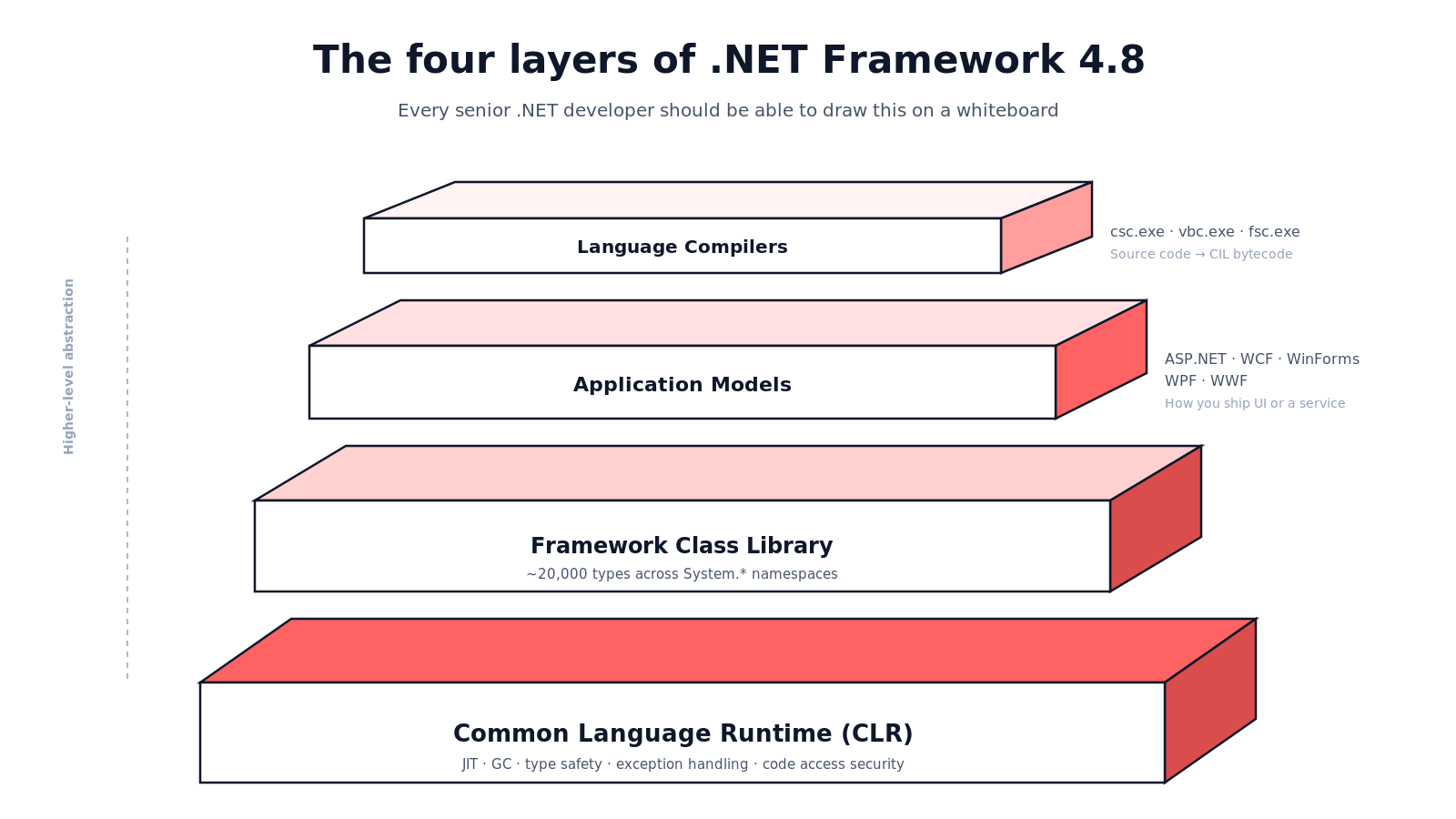
The classic .NET Framework has four architectural layers you need to know to hire, migrate, or debug it. Every senior .NET developer should be able to draw this diagram on a whiteboard. If they cannot, they are not senior yet, no matter what the CV says, and this is one of the two or three questions our team at Versatile uses during technical screens for the India .NET pool.
📇 The four layers
Layer 1: the Common Language Runtime (CLR). The virtual machine that executes managed code. It handles just-in-time compilation, garbage collection, thread management, exception handling, and code-access security. This is the runtime .NET Framework 4.8 ships with, and the direct ancestor of the CoreCLR that unified .NET runs on.
Layer 2: the Framework Class Library (FCL). Roughly 20,000 types organised into namespaces like System.IO, System.Net, System.Data, System.Xml, and System.Windows.Forms. Anything a developer imports as a using statement without adding a NuGet package comes from the FCL.
Layer 3: the application models. ASP.NET (Web Forms and MVC), Windows Forms, Windows Presentation Foundation (WPF), Windows Communication Foundation (WCF), and Windows Workflow Foundation (WWF). Each is a different way to build a UI, service, or workflow on top of the CLR and FCL.
Layer 4: the language compilers. csc.exe for C#, vbc.exe for Visual Basic .NET, fsc.exe for F#. Each compiles source code to Common Intermediate Language (CIL), which the CLR then executes.
| Layer | Purpose | Key APIs / namespaces |
| CLR | Managed code execution | System, System.Threading, System.GC |
| Base Class Library | Core primitives, I/O, collections | System.IO, System.Collections, System.Text |
| Framework Class Library | Higher-level services | System.Net, System.Data, System.Xml, System.Security |
| Application Models | UI and service frameworks | System.Web, System.Windows.Forms, System.ServiceModel |
| Compilers | Source to CIL translation | csc.exe, vbc.exe, fsc.exe |
🧾 What actually gets installed on a Windows machine
When Windows Update installs .NET Framework 4.8, it drops the CLR into C:\Windows\Microsoft.NET\Framework64\v4.0.30319, adds Global Assembly Cache entries to C:\Windows\assembly, and registers file associations for .exe files targeting .NET. This is why the Framework is "machine-wide" and why version conflicts across apps used to be common. The unified .NET model, by contrast, is app-local by default. Every deployment carries its own runtime, or is self-contained with the runtime bundled in. See our pricing page for how we price ops-heavy .NET engineers who spend half their time wrestling with GAC binding.
Q4. Which programming languages target the .NET Framework, and which should you hire for?
The .NET Framework and unified .NET are polyglot platforms. Any language that emits Common Intermediate Language and follows the Common Language Specification can run on the CLR. In practice, three languages carry 99% of production code, and one of them is quietly declining.
💰 The three languages, ranked by hiring demand in 2026
C# is the flagship. Roughly 88% of production .NET code, according to the 2024 Stack Overflow developer survey. Every new .NET codebase, every Microsoft-authored tutorial, every Azure SDK is C#-first. If you are building a new team, hire C# developers. Bengaluru senior C# rates: $28K to $52K/year fully loaded. Compare that against your US or UK line item using our EOR-versus-entity calculator.
F# is the functional language. Small but loyal community, strong in quantitative finance, actuarial workflows, and data-heavy pipelines. Great for teams already writing OCaml or Haskell. Hiring pool in India is thin. Expect 2 to 4 week search per role.
Visual Basic .NET is on a slow, dignified sunset. Microsoft confirmed in 2023 that VB.NET will not receive new language features going forward. Existing code keeps compiling. New projects rarely start in VB. If your legacy is VB.NET, keep the maintainers you have. Do not hire a VB.NET-first developer for greenfield work. That maintainer talent, incidentally, is one of the deepest pools we source through our India EOR, because most of the 45K VB developers left in the market are based in Chennai and Pune, on legacy captive teams.
| Language | Share of new .NET code | India hiring pool | Typical use case | Sr fully-loaded, Bengaluru |
| C# | ~88% | Deep, 850K+ developers | Everything: web, APIs, mobile (MAUI), games (Unity) | $28K to $52K/yr |
| F# | ~4% | Thin, ~2,500 developers | Quant finance, ML pipelines, data engineering | $35K to $65K/yr |
| Visual Basic .NET | ~3% | Aging, ~45K developers | Legacy line-of-business, Office macros | $18K to $32K/yr |
| C++/CLI | ~2% | Very thin | Interop between native C++ and managed .NET | $32K to $58K/yr |
| Other CLS languages | ~3% | Negligible | IronPython, Boo, PowerShell scripting | N/A, hire by task |
Q5. What kinds of applications can you actually build with .NET Framework in 2026?
The .NET Framework's application surface has been frozen since 2019. That is not a bad thing. The workloads it supports are the ones enterprise IT still runs.
🧾 The five workloads that keep .NET Framework in production
ASP.NET Web Forms: server-side event-driven web applications. Older codebases at insurance, banking, and government agencies. Not portable to unified .NET, migration means rewrite (usually to Blazor or ASP.NET Core MVC).
ASP.NET MVC and Web API: modern web patterns from 2009 onwards. Roughly 70% code-portable to ASP.NET Core with Microsoft's upgrade-assistant tool. Most active migration target.
Windows Communication Foundation (WCF): SOAP services, message queues, enterprise integration. Deprecated. Replacement is CoreWCF (an open-source port) or a full rewrite to gRPC or REST.
Windows Forms and WPF: desktop applications. Both are supported on unified .NET 6+, migration is often a single-day project with the upgrade-assistant.
Windows Workflow Foundation (WWF): long-running business workflows. Deprecated. Community port called CoreWF exists, but new work should use Temporal, Azure Logic Apps, or Elsa.
⏰ What the migration timeline actually looks like
Console apps and class libraries: 1 to 3 days per project with upgrade-assistant. Automated for 90% of code.
ASP.NET MVC and Web API: 2 to 8 weeks per medium codebase. The pain is authentication middleware, custom HTTP modules, and third-party NuGet packages that never shipped a Core-compatible version.
Windows Forms and WPF desktop: 1 to 5 days for most, weeks for anything using third-party COM interop.
WCF: 2 to 6 months. Full re-architecture. Consider Azure Service Bus or gRPC.
ASP.NET Web Forms: 6 to 18 months. Effectively a rewrite. Blazor Server is the closest architectural analog.
The point of publishing these numbers up front is that most US and UK founders under-estimate the migration by half. They see the upgrade-assistant tool, they read a Microsoft blog post about "seamless" migration, and they budget six weeks for what is a six-month project. Getting the calendar right up front is the single highest-leverage decision. Our intake flow walks through that timeline sizing before we even talk about hiring.
"Response times stretch during peak payroll periods, a recurring complaint across G2 and Capterra. Response time at the entry tiers is slower than at the enterprise tier."
— Verified Users, Deel review analysis based on G2 verified reviews, HRstacks 2026
The technology decision is easy. The migration is where the calendar goes.
Q6. What are the honest advantages and limitations of .NET Framework today?
The .NET Framework is not obsolete. It is frozen and specialised. The advantages hold in the workloads it was built for. The limitations kick in the moment you leave those workloads.
⭐ What .NET Framework still does well
Native Windows integration: WMI, IIS, MSMQ, Active Directory, COM. Nothing on unified .NET matches the depth. If your app is fundamentally a Windows enterprise app, the Framework is often still the cleaner platform.
Stability: no breaking changes since 2019. Ops teams love this. Compliance teams love this. Every quarterly upgrade to .NET 9 or 10 is a change-management event; a 4.8 app is not.
Ecosystem depth for legacy patterns: 20 years of Stack Overflow answers, NuGet packages, and enterprise integration code. Any obscure SOAP or WMI use case has a documented solution.
Talent availability: developers who have shipped Framework since 2010 are abundant, especially in India. Bengaluru has roughly 180,000 developers with 5+ years of Framework experience. For US and UK founders trying to staff a maintenance-mode 4.8 team without opening an Indian entity, an India-native EOR is the standard path and covers PF, ESI, TDS, and S&E across all 28 states.
❌ What .NET Framework can no longer do
Cross-platform: Windows only. Linux and macOS are non-starters. Container images are Windows-container-only, which means a 5GB base image versus the 80MB Linux base on unified .NET.
Modern cloud-native patterns: Kubernetes operators, service mesh sidecars, and serverless-first architectures assume Linux and small startup times. Framework struggles.
Language features past C# 7.3: no records, no pattern matching, no top-level statements, no async streams. If you want modern C#, you need unified .NET.
Cloud-first observability: OpenTelemetry, native structured logging, and modern APM are unified-.NET-first. Framework has back-ports; they are second-class.
| Situation | Keep .NET Framework 4.8 | Migrate to .NET 10 |
| Enterprise ASP.NET Web Forms app, stable, low change rate | Yes, for now | Only if the business drives it |
| ASP.NET MVC internal tools, actively developed | No | Yes, in 2026 or 2027 |
| New web API or microservice, greenfield | No | Yes, .NET 10 LTS from day one |
| WinForms internal tool, works fine | Yes | Optional, low ROI |
| WCF SOAP service | Yes, until re-architecture is funded | Only with 2 to 6 month plan |
| Mobile or cross-platform new app | No, Framework cannot ship this | Yes, use .NET MAUI on .NET 10 |
| Container-first cloud deployment | No | Yes, Linux base image |
Q7. What does hiring senior .NET talent in India actually cost and look like in 2026?
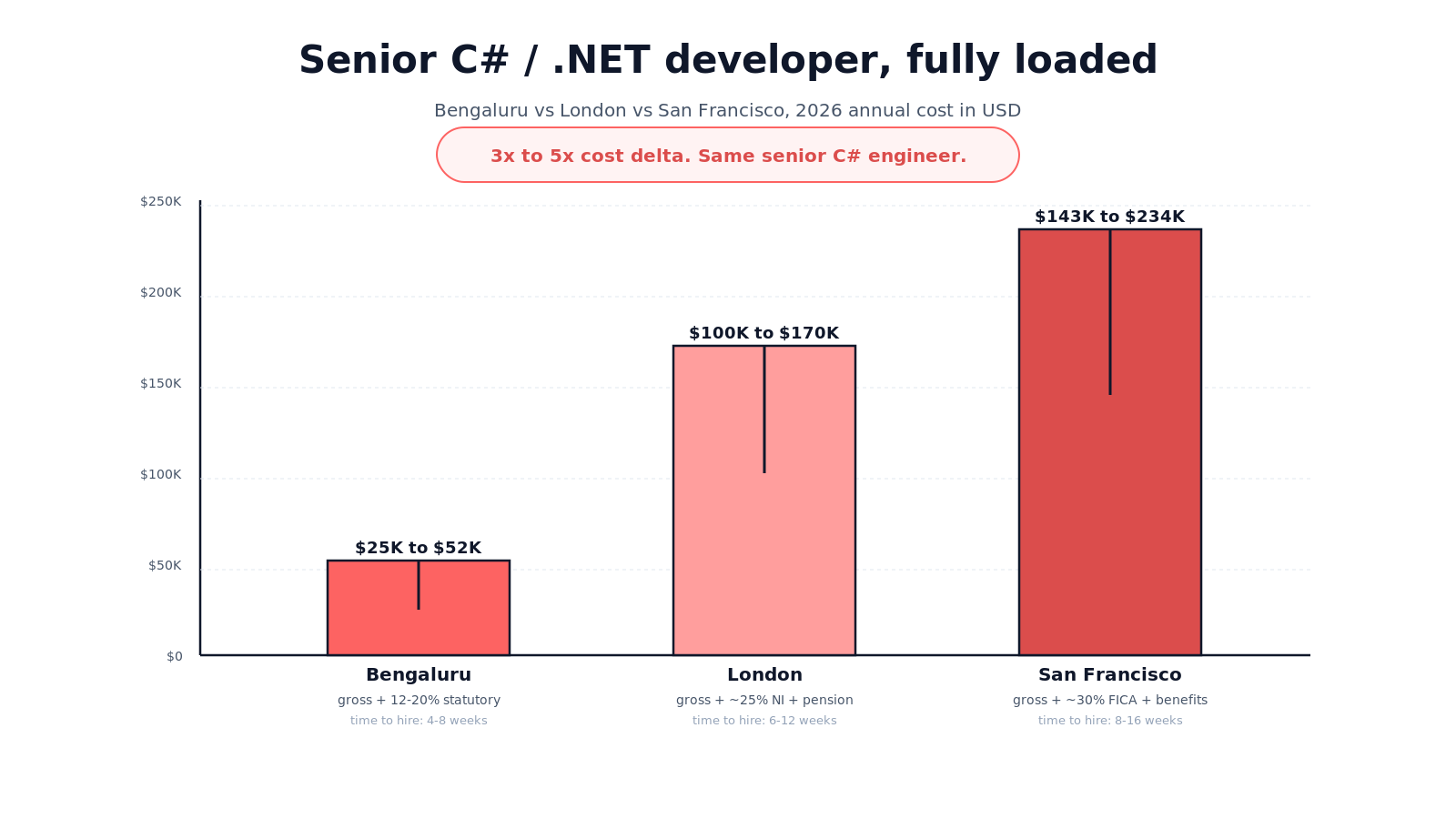
India has the second-largest .NET developer population in the world. Roughly 850,000 active C# developers by 2024 estimates, concentrated in Bengaluru, Hyderabad, Pune, and Chennai. The cost differential versus US or UK talent is 3x to 5x. The compliance overhead is what most US founders under-count.
💰 The all-in salary math
Fully-loaded cost for a senior C# / .NET developer in India, 2026, includes gross salary, statutory contributions (PF 12% employer, ESI up to ₹21K salary cap, gratuity 4.81% of Basic+DA), professional tax (state-specific), Shops & Establishment registration per office location, and the payroll cadence (monthly, in INR, with Form 16 at year-end). Add 12 to 20% on top of gross for statutory load. Our India compliance guide walks through each statute in detail.
| Location | Gross salary range | Statutory load | Fully-loaded total | Time-to-hire |
| Bengaluru, senior C# | ₹18L to ₹36L ($22K to $43K) | 12 to 20% | $25K to $52K/yr | 4 to 8 weeks |
| Hyderabad, senior C# | ₹16L to ₹32L ($19K to $38K) | 12 to 20% | $22K to $46K/yr | 4 to 8 weeks |
| Pune, senior C# | ₹15L to ₹30L ($18K to $36K) | 12 to 20% | $21K to $43K/yr | 4 to 8 weeks |
| US, senior C# | $110K to $180K | ~30% (benefits + FICA) | $143K to $234K/yr | 8 to 16 weeks |
| UK, senior C# | £65K to £110K | ~25% (NI + pension) | £81K to £137K/yr | 6 to 12 weeks |
⚠️ The three ways US founders get India hiring wrong
Trap 1: paying as a "contractor" via Deel or a generic contractor platform. India tax law treats a full-time worker with fixed hours, defined tools, and a manager as an employee regardless of what the contract says. Misclassification risk: $25K to $40K per head in back-taxes, penalties, and legal fees.
Trap 2: opening an Indian private limited company (Pvt Ltd) for the first 2 to 5 hires. Incorporation, DIN, DSC, MCA compliance, statutory audits, secretarial filings, and quarterly TDS returns cost $8K to $15K per year regardless of headcount. Break-even versus an India-native EOR is 10 to 15 hires. Below that, you are burning capital.
Trap 3: using a global EOR (Deel, Multiplier, Remote, Rippling) whose India operation is a sub-processor. You get an English-language dashboard and English-language support, but the actual employment contract is signed by their local partner, and the compliance responsibility ends up in a grey zone. When PF/ESI audits happen, you find out who is really on the hook.
"Good value but the platform has rough edges. We had some payroll delays in month one and the dashboard isn't as intuitive as Deel's."
— Verified Customer, Multiplier - G2 Verified Review analysis 2026
"There isn't a more advanced option for contractors, and there seems to be less loyalty or fewer perks than with other companies or platforms that offer more discounts and a wider variety of options."
— Verified User in HR, Remote - G2 Verified Review
✅ Where Versatile fits
Versatile is an India-native Employer of Record built specifically for US and UK companies hiring their first .NET developer in India. Not a sub-processor. Not a global EOR bolting on an India module. We are Foo Falcon Technologies Pvt Ltd, CIN U72900KA2022PTC163007, an Indian private limited that has employed 47 engineers across 14 US and UK companies over the last four years, with zero compliance notices since founding.
What that means in practice for hiring a .NET developer: a real Indian employment contract with your job spec and salary, PF and ESI registered for the employee on our entity, monthly payroll in INR with Form 16 at year-end, S&E registration in whichever state your developer lives (all 28 covered), and a 5-day contractual go-live SLA from offer-accept to first day. Our rate is $349 per employee per month, first month free. See pricing and how it works.
Q8. How do you migrate a .NET Framework codebase to unified .NET in 2026?
Microsoft's official tool is the .NET Upgrade Assistant, a CLI plus Visual Studio extension. It analyses your .csproj, identifies API changes, and applies most of the mechanical edits automatically. It is genuinely good. It is also not magic. The three parts you still write by hand are authentication middleware, third-party NuGet compatibility, and any workload that touched WCF or Web Forms.
🔁 The five-step migration workflow
Step 1: run the .NET Portability Analyzer against your existing solution. It produces a report of which APIs are unavailable in unified .NET, per project. Anything under 90% API compatibility should be flagged for detailed planning.
Step 2: upgrade dependencies to the highest .NET Framework 4.8-compatible versions. Older NuGet packages often shipped a Core-compatible version later. This step alone unblocks 30 to 50% of migration blockers.
Step 3: run the .NET Upgrade Assistant on a copy of the solution. It re-targets .csproj files, applies namespace changes, updates configuration to appsettings.json, and generates a migration report. On a 200K LOC C# codebase, expect 60 to 80% of files to migrate without hand-edits.
Step 4: fix the residual failures. This is where team experience matters. Most residual work is authentication (System.Web to ASP.NET Core Identity), custom HTTP modules (to middleware), and packages that never shipped a Core version (replace or fork).
Step 5: parallel-run in a staging environment for 4 to 8 weeks before cutover. Log both versions, diff the outputs, then cut over feature by feature. Our engagement model covers exactly this cadence when the migration engineer is on our books.
💸 The hidden cost most estimates miss
The upgrade tooling gets you 70% of the way. The last 30% is team time. For a typical 250K LOC ASP.NET MVC + Web API codebase, expect 4 to 6 months of one senior engineer's time to reach production parity. This is where a well-run India team (2 to 3 developers plus one architect) becomes the ROI-positive path: the same migration at US rates is $180K to $280K in labour; run in India with our India-native EOR, it lands at $55K to $95K. Run the numbers for your codebase in the calculator.
"When it comes to withdrawals to local bank accounts, Deel relies on third-party providers that constantly block transfers due to vague 'additional checks.' Funds can be held for far longer while these endless verification requests are processed."
— Verified Contractor, Deel - G2 Verified Review analysis, HRstacks 2026
"Country surcharges aren't published on the pricing page. Brazil, France, and India add $50 to $150 per employee above base."
— Verified Users theme, Deel - Aggregated G2 review analysis, Alcor 2026
Q9. When should you keep .NET Framework, and when is it time to move?
Not every .NET Framework codebase needs to migrate in 2026. Some should stay on 4.8 for another 5 years. Some should have migrated last year. The decision comes down to four axes.
🤔 The four axes of the migration decision
Axis 1: business change rate. If the codebase gets a feature every quarter or more, migrate. If it gets a security patch every six months and nothing else, keep.
Axis 2: Windows dependency. If the app is deeply integrated with WMI, MSMQ, Active Directory, or COM, the migration is genuinely hard. Cost-benefit is against migration for stable apps.
Axis 3: talent trajectory. Junior developers hired in 2024 or later have often never shipped Framework in production. If you cannot hire people who want to work on 4.8, the codebase gets orphaned regardless of your architecture plan. In India, the 4.8 maintainer pool is still deep enough to hire from, and that is one of the main reasons US and UK founders route Framework maintenance work through our India EOR.
Axis 4: performance and cloud pressure. If you need Kubernetes-first deployment, sub-100ms cold starts, or Linux containers, Framework cannot ship them. Migration is not a choice.
The way to read the four axes: if three or more point toward migration, plan the 2026 or 2027 window. If two or fewer, stay on 4.8, take the security patches, and let the codebase live out its Windows lifecycle. If the hiring pool axis is the one screaming, that is the axis most founders under-weight, and the reason a well-built India team is often the deciding variable. Run the EOR-versus-entity calculator against your team size before you commit to either path.
🚧 The one migration mistake I see the most
Founders and CTOs try to migrate everything at once. Big-bang migrations fail 60% of the time. The pattern that works is strangler-fig: build new features in .NET 10 alongside the existing 4.8 app, route traffic gradually, and let the old surface shrink over 6 to 18 months. Every successful migration I have seen at Versatile has followed this pattern. Every failed one has been a big-bang.
Q10. What does the future roadmap for .NET look like beyond .NET 10?
Microsoft's public roadmap is now predictable enough that you can plan hiring and architecture on it. Annual releases every November. LTS every two years, with three years of support. STS releases (odd years) as bridge versions. This cadence has held from .NET 5 (2020) through .NET 10 (2025).
⏰ What the next 4 years look like
.NET 10 (Nov 2025, LTS): the default for any greenfield work in 2026. Three years of support (through Nov 2028).
.NET 11 (Nov 2026, STS): incremental. Better AOT, more Blazor patterns, better observability. Don't standardise.
.NET 12 (Nov 2027, LTS): the migration target for anything running on .NET 8 or .NET 10 in 2028.
.NET 13 (Nov 2028, STS): expected to continue the annual cadence.
Classic .NET Framework 4.8.1: no new releases planned, security patches only, follows the Windows lifecycle. Extended support through the 2030s for Windows Server 2022 and Windows 11 22H2.
🚀 The architectural direction to bet on
Three shifts are worth staffing for in 2026 and 2027. First, ahead-of-time compilation (AOT) is becoming default for ASP.NET Core services, cutting cold start from seconds to milliseconds and image size from 200MB to 40MB. Second, Blazor United (introduced in .NET 8, matured in .NET 10) collapses server-rendered and client-rendered React-style patterns into one component model. Third, .NET MAUI is the credible cross-platform mobile play for teams already in the .NET ecosystem, and mobile-first India teams can ship iOS + Android + Windows from a single codebase.
✅ How to staff for it in India
Hire C# 12 developers who have shipped at least one project on .NET 8 or later. That eliminates 60% of the resume pool (still leaves 340,000 in India) but guarantees baseline currency. Ask about async streams, minimal APIs, and source generators. If they know these, they have written modern .NET. If they only know Web Forms and 4.5-era patterns, they are Framework-legacy talent, which is fine for 4.8 maintenance and a mismatch for greenfield .NET 10.
"New admins take weeks to find their footing. Help docs skew toward contractors, and product docs for EOR employers are thinner than expected."
— Verified Users theme, Deel - G2 Verified Review analysis, HRstacks 2026
"Multiplier's flat-fee pricing is expensive for lower-cost markets. New users may face a learning curve with the platform interface and email support response times can be inconsistent."
— Verified Users summary, Multiplier - G2 Verified Review analysis, HRstacks 2026
Q11. How does an India-native EOR change the .NET hiring math for a US founder?
The last section is about the operational reality of running an India .NET team, not the architecture. Because for most US and UK founders reading this, the question is not "should we use .NET Framework or .NET 10." It is "how do we get from zero to a working India engineering team without burning six months on compliance."
🧾 The compliance stack you inherit the moment you hire
Every full-time .NET developer you hire in India brings the same statutory obligations, regardless of vendor. Provident Fund (PF) at 12% employer + 12% employee on Basic+DA up to ₹15K/month wage ceiling. Employee State Insurance (ESI) at 3.25% employer + 0.75% employee for salaries up to ₹21K/month. Gratuity at 4.81% of Basic+DA, payable after 5 years. Professional tax, state-specific, roughly ₹200/month. Shops & Establishment registration in the state where the employee is physically located. TDS on salary at applicable slab rates, monthly deposit, quarterly returns. The Code on Wages plus the three other Labour Codes (effective 21 November 2025) require Basic+DA to be at least 50% of CTC, 48-hour full-and-final settlement on exit, and the DPDP Act (2023) for employee data. See our compliance page for the full statutory checklist.
💰 What an India-native EOR actually prices in versus a global EOR
| Dimension | India-native EOR (Versatile) | Global EOR (Deel, Multiplier, Remote) |
| Employment contract signed by | Versatile's Indian entity, on Indian law | Their local partner (sub-processor) |
| PF/ESI compliance | Directly on our entity, verifiable on EPFO portal | Via partner, you cannot verify |
| Support channel for the employee | WhatsApp to a named HR partner, IST hours | Global ticket queue, US/EU hours |
| S&E registration | All 28 states pre-covered | State-by-state, may take 4 to 8 weeks |
| Contract type | Real Indian employment contract | Often a services agreement (contractor-shaped) |
| Monthly rate | $349/emp/month, first month free | $599 to $899/emp/month |
| Go-live SLA | 5 days, contractual | 10 to 21 days typical |
| Audit response | We handle end-to-end | Partner handles, you get updates |
"The deposit catches buyers off guard. 1 to 1.5 times monthly cost, not on the pricing page. New admins take weeks to find their footing."
— Verified Users summary, Deel - G2 Verified Review analysis, HRstacks 2026
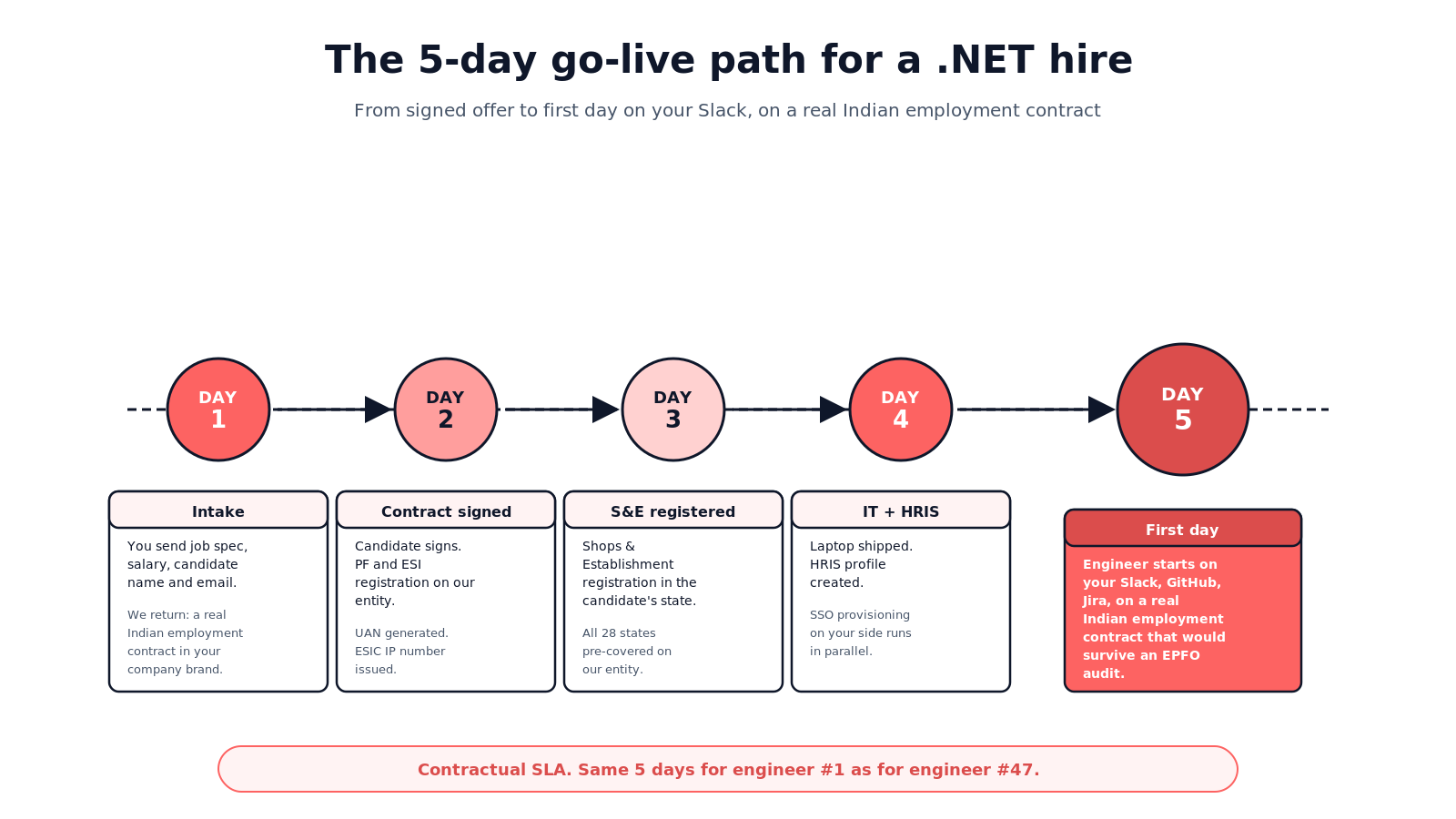
🚀 The 5-day go-live path for a .NET hire
Day 1: you send us the job spec, the offered salary, and the candidate's name and email. We send back a real Indian employment contract in your company's brand.
Day 2: candidate signs. We register them on PF and ESI portals, generate their UAN and IP number.
Day 3: we complete S&E registration in the candidate's state (or activate the existing one).
Day 4: laptop shipped, IT onboarding, HRIS provisioning.
Day 5: first day. Your engineer starts on your Slack, your GitHub, your Jira, on a real Indian employment contract that would survive an EPFO audit. See how it works or run the EOR-versus-entity calculator for your specific team size.
FAQs
Is the .NET Framework still supported in 2026?
Yes, but only for security patches. Version 4.8.1 (released August 2022) is the last major release. Microsoft has confirmed no further versions. Support tracks the Windows OS lifecycle. Windows Server 2022 gets extended support into the 2030s, so 4.8.1 apps running on it are safe for another 5+ years. New development should target unified .NET (currently .NET 10 LTS).
What is the difference between .NET Framework and .NET 10?
.NET Framework is Windows-only, proprietary, and frozen at version 4.8.1. .NET 10 is cross-platform (Windows, Linux, macOS), open-source under MIT, and ships annually. They share vocabulary (C#, CLR, class library) but they are architecturally different runtimes. Framework installs machine-wide, .NET 10 ships per-app. Framework container images are Windows-only and 5GB+, .NET 10 Linux images are 80MB.
Can I migrate a .NET Framework app to .NET 10 automatically?
The .NET Upgrade Assistant (a Microsoft CLI + Visual Studio extension) automates 60 to 80% of the mechanical work: .csproj retargeting, namespace changes, config migration to appsettings.json. The 20 to 40% you write by hand is authentication middleware, custom HTTP modules, and any workload that used WCF or ASP.NET Web Forms. A typical 250K-LOC ASP.NET MVC codebase migrates in 4 to 6 months of one senior engineer's time.
How much does a senior .NET developer cost in India in 2026?
Bengaluru senior C# rates run $22K to $52K/year fully loaded (gross salary plus 12 to 20% statutory load for PF, ESI, gratuity, professional tax, TDS admin, and S&E registration). Hyderabad is roughly 10% cheaper, Pune 15%. Compare to US senior C# at $143K to $234K/year fully loaded, or UK at £81K to £137K. Time-to-hire in India is 4 to 8 weeks for senior C#, versus 8 to 16 weeks in the US.
Do I need an Indian entity to hire a .NET developer in India?
No, not below 10 to 15 hires. An India-native EOR (Employer of Record) is the ROI-positive path for the first 10 hires. Opening a Pvt Ltd costs $8K to $15K per year in ongoing compliance (statutory audits, MCA filings, quarterly TDS returns) regardless of headcount, so the break-even is 10 to 15 employees. Above that, opening your own entity starts to make financial sense. Use our EOR vs entity calculator to model your specific team, or see Versatile's pricing for the exact monthly rate.
Which .NET version should we standardise on for greenfield work in 2026?
.NET 10, the LTS release from November 2025. Three years of Microsoft support (through November 2028), all modern language features, first-class Linux container support, AOT compilation default for ASP.NET Core. Skip .NET 9 (STS, out of support May 2026) unless you are already running it. Skip .NET 8 (LTS, out of support November 2026) for greenfield, but stay on it if it is already in production and stable.
What is the difference between .NET Framework, .NET Core, and .NET?
.NET Framework is the classic Windows-only runtime (2002 to 2019, frozen at 4.8.1). .NET Core (2016 to 2019) was the cross-platform open-source rewrite, versions 1.0 through 3.1. In 2020, Microsoft dropped the "Core" suffix and started calling it just ".NET" (versions 5, 6, 7, 8, 9, 10). So .NET Core 3.1 and .NET 5 are the same family, and .NET 5 onwards is what is now called "unified .NET" or just ".NET."
Should we hire C#, F#, or Visual Basic .NET developers for a new team?
Hire C#. Roughly 88% of production .NET code is C#, every new Microsoft tutorial is C#-first, and India has 850K+ active C# developers. F# is niche (quant finance, ML pipelines), thin talent pool, hire only if you have a specific functional-programming use case. VB.NET is in maintenance mode, no new language features going forward, useful only for maintaining legacy Windows Forms line-of-business apps. See our India EOR service for how we source and onboard C# engineers in Bengaluru, Hyderabad, and Pune.
Where my head is right now
Here is the prediction I am sitting with. Over the next two years, US and UK founders will keep two .NET codebases in parallel: a frozen .NET Framework 4.8 line-of-business surface that stays in extended support until the underlying Windows retires, and a .NET 10 greenfield surface where everything new gets built. The teams that ship faster will be the ones who ran both from India, because Bengaluru has both the legacy Framework maintainers and the modern .NET 10 talent, and neither is scarce.
If you are hiring your first .NET developer in India or migrating a Framework codebase and want to think through the entity-versus-EOR call, message me directly on WhatsApp through our contact page, or book a consultation with us. You will be talking to the founder of the India-native EOR, not a ticket queue. What is the one thing about hiring in India that you wish someone would just tell you straight?
Ready to hire in India?
Drop your work email · we'll set up a 20-min intro call within 24 hours. Tell us what you're building; we'll tell you whether we're the right fit.
We reply in business hours (IST). Never spam, never share your email.